
Maricopa Criminal History Checks
Maricopa has a city police department and a stand-alone Municipal Court, so the first steps stay at city altitude. The city police records unit is the source for a Maricopa incident or arrest report. The Municipal Court holds city ordinance, misdemeanor, DUI, traffic, and protective-order records. Western Pinal Justice Court and Superior Court cover different county and felony paths.
- Ask whether the record began with Maricopa Police, another agency, or a court.
- Submit a city police request through Maricopa JustFOIA or at the police records lobby.
- Use Arizona Public Access to locate a case, then request the official file from Maricopa Municipal Court when it is a city matter.
- Check Western Pinal Justice Court or Superior Court when the case is outside municipal jurisdiction.
- Use Pinal Adult Detention for current custody, or Arizona DPS record review for your own statewide criminal history.
This sequence keeps the police narrative, court disposition, current custody record, and repository history from being confused with one another.
Arizona DPS does not supply a public name-based repository search for private citizens. A person can review their own Arizona record for accuracy through the DPS Public Services Portal or a fingerprint-based paper packet. That state process is distinct from a Maricopa Police report and from an online court index result. Use it when the question is the completeness of your own repository history, not when the goal is a city incident narrative.
Maricopa Police Records Use Lobby and JustFOIA
Maricopa Police Records maintains and facilitates public requests for department reports. A requester can use the city’s JustFOIA site or visit the lobby window. The police page says records are electronically scanned and retained under Arizona State Library, Archives and Public Records requirements and Arizona law.
The Maricopa JustFOIA portal is the source for the first successful city image in the manifest.
The portal provides an online route for city police public records, while the records lobby remains an alternative for a person who needs in-person help.
Useful details include the incident date, location, report number if known, parties tied to the event, and a clear description of the material sought. Criminal reports can require redaction under Title 39, so their release path may differ from a routine non-criminal incident report.
Records at the Maricopa Police Department
Maricopa Police Records is a city custodian, not the holder of every case involving a Maricopa address. It controls reports created by its officers. Dispatch is listed at 520-568-3673, police administration at 520-316-6800, and city public-records questions at 520-568-9098.
The lobby has unusually broad published hours: Monday through Thursday from 7 a.m. to 6 p.m., and Friday from 8 a.m. to 5 p.m. The department says non-criminal incident and crash reports can usually be released within five days when release is authorized. Criminal reports are reviewed and redacted as required, which can change the time and material provided.
A police report records what the agency documented. It does not supply the final plea, dismissal, conviction, or sentence. Those outcomes come from the court file.
The records office also handles vehicle tow hearing requests, another reminder that its workload is broader than criminal reports. A tow hearing file is not a criminal-history substitute. If the underlying event led to a citation or charge, use the report number and event date to look for a separate Municipal Court, justice-court, or Superior Court case.
Maricopa Court Records Changed in 2023
Maricopa opened its stand-alone Municipal Court on January 3, 2023. The city had used a shared or co-located court model with Pinal County after incorporation in 2003. The new court created a dedicated city branch for Maricopa ordinance violations, traffic cases, misdemeanors, protective orders, and DUIs.
The official Maricopa Municipal Court page supplied another successful manifest image.
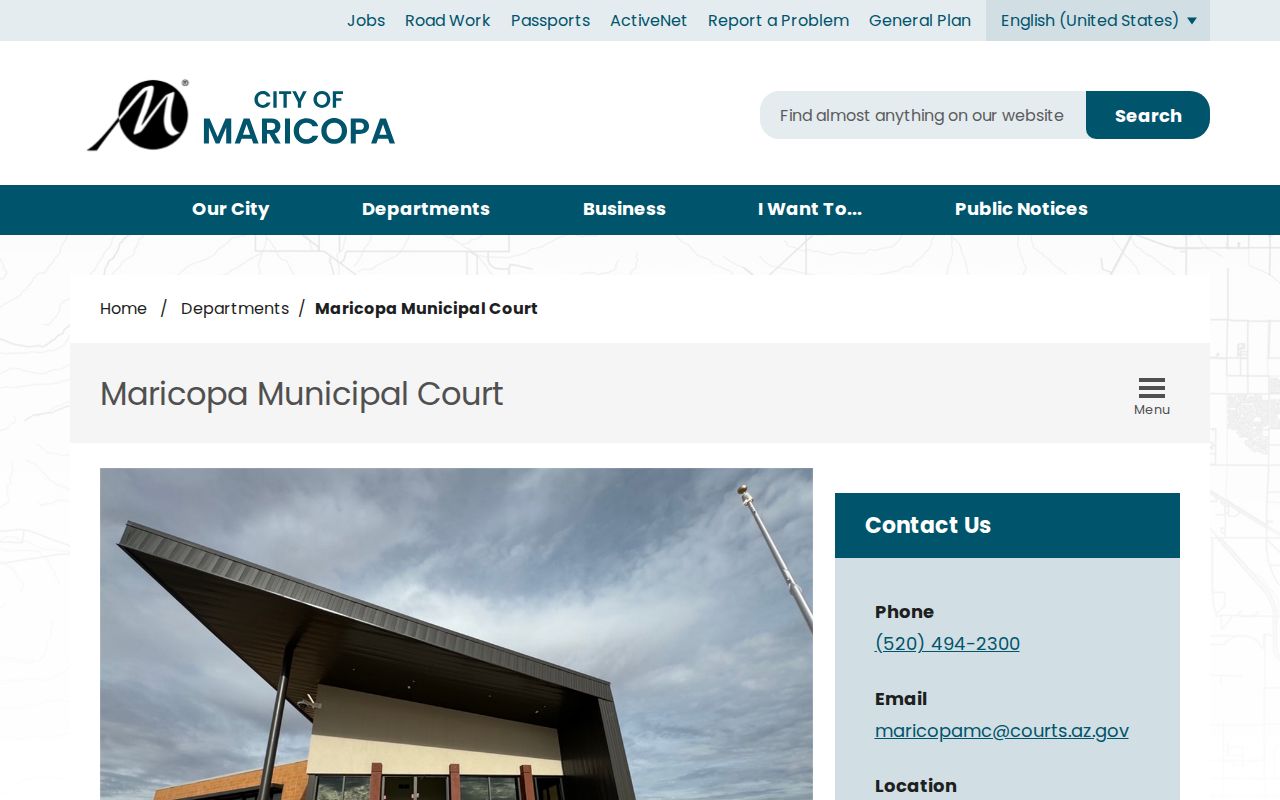
The page marks the city court as a distinct records destination. That history is important when tracing older Maricopa matters because the filing court and date can point to a different custodian.
Booking and Arrest Records in Maricopa
A Maricopa Police arrest starts with an agency report. If the person is booked into Pinal County Adult Detention, a separate custody entry is created in Florence. The case then goes to Maricopa Municipal Court, Western Pinal Justice Court, or Superior Court based on filing authority and charge level.
The county inmate search lists only people currently incarcerated and refreshes every 60 minutes. Once a person is released, that person no longer appears. A blank result cannot be treated as proof that no Maricopa arrest took place. Adult Detention directs questions about bond and court dates to 520-509-7957.
For an older arrest, request the police report, then search the correct court for the result. The broader Pinal County arrest search page covers custody and repository routes without turning the city page into a county-wide guide.
Western Pinal Court Records in Maricopa
The stand-alone Municipal Court did not eliminate the Western Pinal Justice Court. JP4 serves Maricopa and Stanfield from 19955 N Wilson Avenue, Maricopa, AZ 85139. Its listed phone is 520-866-3999. It handles justice-court matters within its jurisdiction, while the city court handles the city docket.
A searcher should use the filing agency and charge type to pick between the two. City ordinance, city misdemeanor, DUI, and traffic matters may belong to Municipal Court. Justice matters can remain with JP4, and felony matters can move to Pinal County Superior Court after probable cause. Arizona Public Access can help identify the court, but the official file stays with that court.
JP4 lists cash, cashier’s check or money order, credit or debit card, and PayNearMe among payment methods. Personal checks are not accepted. Payment rules do not replace a records request or establish the status of a criminal case.
The Maricopa Municipal Court File
Maricopa Municipal Court is at 39600 W Civic Center Plaza, Maricopa, AZ 85138. Its phone is 520-494-2300, and its published hours are Monday through Thursday from 8 a.m. to 5 p.m. The court lists Judge Stephen F. McCarville and the email maricopamc@courts.az.gov.
| Court Name | Maricopa Municipal Court |
|---|---|
| Case Types Heard | City ordinances, misdemeanors, traffic, DUIs, protective orders, and related city matters |
| Case Lookup Channel | Arizona Public Access for available index data, followed by the court’s written records request |
| What the File Shows | Case number, charges, hearings, public orders, pleas, disposition, sentence, and warrant or bond events when available |
| Copies and Fees | $0.50 per page, $17 certification per case, and a $17 name-search research fee under the stated limits |
Online data can be free when it is available, but it is not the official record. A certified copy must come from the court.
Public Access itself has limits that shape a Maricopa search. It covers most Arizona courts, requires a CAPTCHA, and updates weekly on Friday with data through the preceding Wednesday. Some local ordinance matters do not appear. The portal also excludes sealed cases, juvenile delinquency information, victim and witness data, mental health and probate matters, and orders of protection. When a known case is absent, call the likely court rather than treating the blank screen as a final answer.
Maricopa Court Record Requests Take Time
The Municipal Court requires records requests in writing. Its form asks for the requester’s name or agency, the requested information, and a delivery preference for pickup, mail, or email. Requests may be delivered at the front counter, mailed to the Civic Center Plaza address, or emailed to the court.
The court says processing takes 7 to 10 business days depending on request size. A $17 research fee covers a name search of up to three names or three cases per name under A.R.S. 22-404. Certification is $17 per case, plus the $0.50 per-page copy charge.
The Municipal Court records and fees page is the source for the third successful Maricopa image.
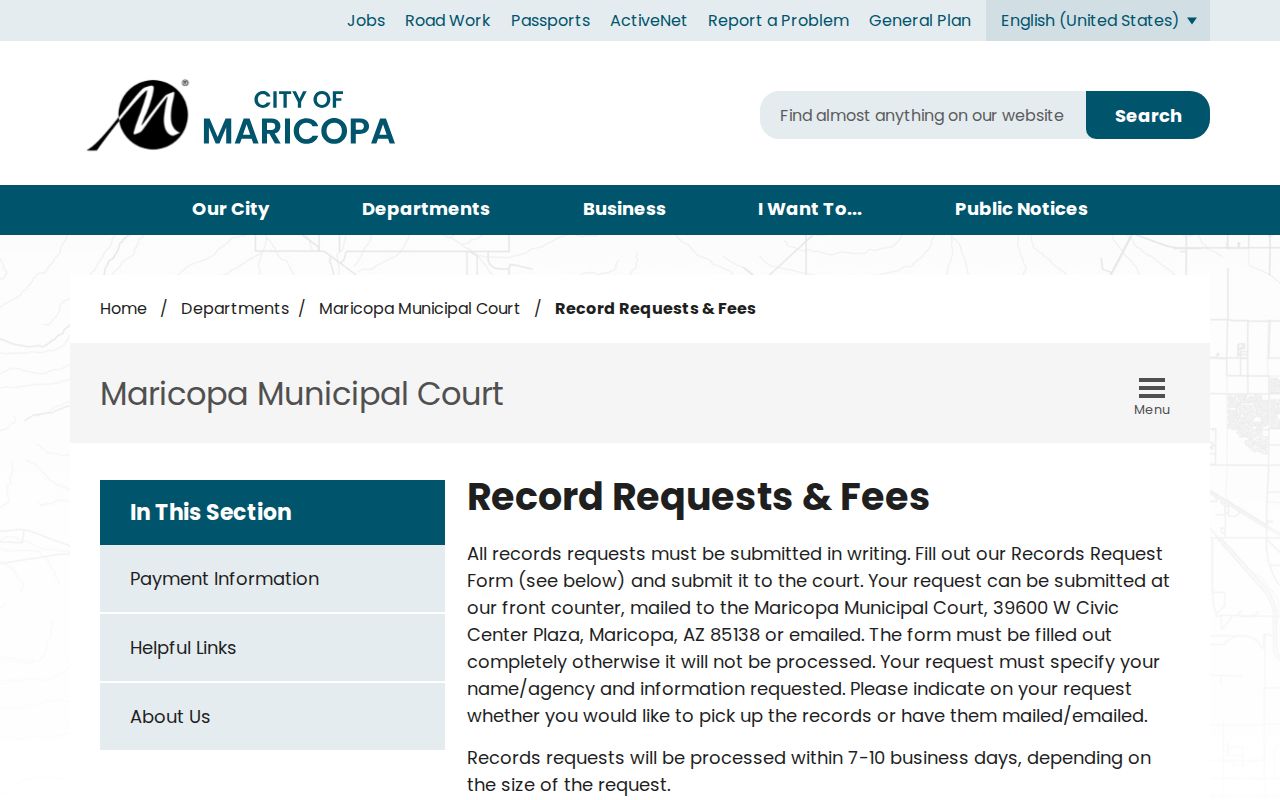
The image supports the practical lesson: identify the case through Public Access first when possible, then submit a complete written request to avoid needless research work.
How Maricopa Records Reach the County
A Maricopa incident does not remain in one city file. Police maintain the report. The court that receives the charge creates its own case. Pinal Adult Detention creates the booking record if county custody occurs. Fingerprint-supported arrest and disposition information may later be reported into Arizona’s state repository.
Record flow: Maricopa Police Department › Maricopa Municipal Court, Western Pinal Justice Court, or Pinal County Superior Court › Arizona Department of Public Safety Central State Repository
The city report is strongest for the incident narrative. The court file is the source for the formal charge and outcome. A subject-only DPS review is the route for checking the accuracy and completeness of your own Arizona criminal-history record, not a public Maricopa name search.
Maricopa City Records and Felony Files Split
A common search error is assuming that every Maricopa case remains at Municipal Court. The court’s subject-matter limits matter more than the city address. Felonies ultimately belong in Superior Court after probable cause, while some lower-level county cases belong to Western Pinal Justice Court.
Pinal County reports that about 98 percent of felony probable-cause matters go to grand jury, while about 2 percent use a preliminary hearing. After an indictment, a person searching only a local or justice docket could miss the later Superior Court file. Search by case number where possible and confirm the transfer with the court of record.
What Maricopa Record Sources Can Show
Each Maricopa source answers a different question. Police records can show the report number, date, location, involved agency, alleged offense, and releasable narrative. Jail data can show current custody and booking-related information. Court records add filings, hearings, charges, plea or trial activity, disposition, sentence, and public warrant events.
- Incident report
- The Maricopa Police account of an event, subject to lawful redaction.
- Booking record
- A Pinal County custody record created if the person is accepted at Adult Detention.
- Municipal case
- A city court file for matters within Maricopa Municipal Court jurisdiction.
- Justice case
- A JP4 file for a matter within Western Pinal Justice Court jurisdiction.
- Disposition
- The court’s final outcome, which cannot be inferred from an arrest alone.
Names are not unique identifiers. Cross-check the court, case number, date, and filing agency before deciding that records refer to the same event.
The order of updates also matters. Maricopa Police can hold a report before the prosecutor files a case. Adult Detention can show a current booking before the weekly state court index changes. The court may later add a dismissal, conviction, acquittal, sentence, or recalled warrant. Repository data can follow after fingerprint and disposition reporting. A complete timeline often requires more than one custodian.
Maricopa Record Access Rules
Arizona law supports inspection and copy requests, but it does not make every field public. Maricopa Police may redact protected identifiers, victim or witness information, juvenile material, and information restricted by law. Court records follow Arizona Supreme Court access rules, while the DPS repository has separate dissemination limits.
Key Statutes:
A.R.S. 39-121 opens public records for inspection during office hours unless law restricts them.
A.R.S. 39-121.01 governs public copy requests and permits advance copying or postage payment.
A.R.S. 41-1750 establishes the state repository and controls dissemination of criminal-history information.
Arizona Public Access excludes categories such as sealed cases, juvenile delinquency information, victim and witness data, mental health and probate matters, orders of protection, and some local ordinance charges. Verify any needed case with the office holding the original Maricopa file.